Carpet Area, Built-Up Area, and Super Built-Up Area: The Complete Guide for Indian Homeowners
Confused by real estate terms? Learn the exact difference between carpet area, built-up area, and super built-up area to plan your house construction perfectly.
Published
March 6, 2026
Reading Time
1 Min Read
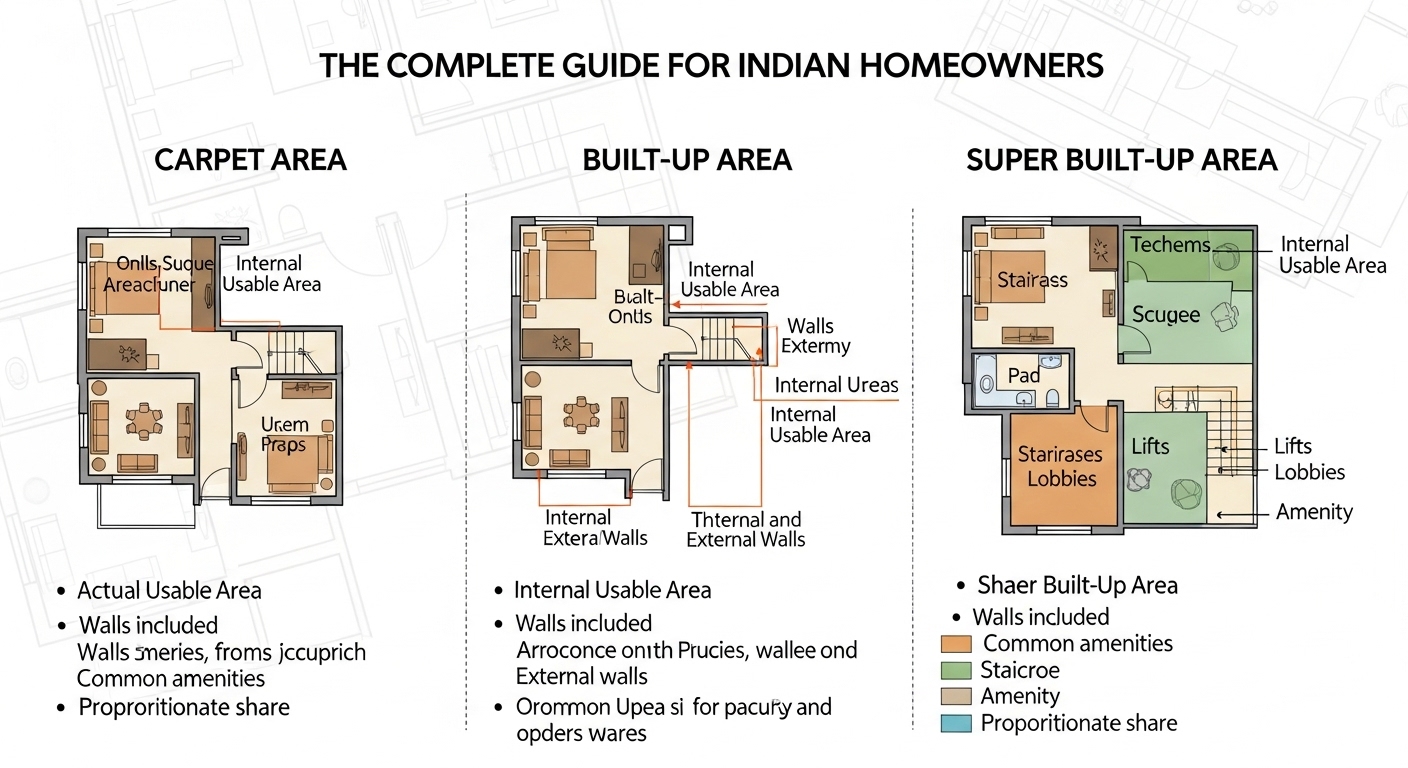
Whether you are buying a vacant plot of land, purchasing a high-rise flat, or working with an architect to design your independent dream home, you will inevitably be bombarded with complex real estate jargon. Among the most confusing and frequently misunderstood terms for first-time builders and buyers are "Carpet Area," "Built-Up Area," and "Super Built-Up Area."
Misunderstanding these three foundational terms is the number one reason homeowners feel short-changed during the construction or buying process. You might think you are paying to build a 1,200 square foot home, only to step inside the finished building and wonder where all the space went.
Before the Real Estate (Regulation and Development) Act, 2016 (RERA) was established, the lack of standardization allowed some developers to inflate property sizes, leading to massive confusion. Today, transparency is legally mandated, but understanding how these measurements impact your specific architectural blueprint is entirely your responsibility.
In this exhaustive, comprehensive guide, we will break down exactly what these terms mean according to Indian real estate laws, how to calculate them mathematically, and how PlanMyPlot helps you maximize your usable space during the architectural design phase.
1. What is Carpet Area? (The Space You Actually Live In)
To understand this term, visualize unrolling a massive wall-to-wall carpet inside your house. The total floor area that the carpet covers perfectly is your Carpet Area.
It is the net usable floor area of your home. It includes the space inside your living room, bedrooms, bathrooms, and kitchen.
The Official RERA Definition
The introduction of RERA brought a strict, legal definition to this term to protect buyers from fraud. According to the Act, the RERA carpet area refers to the net usable floor area of an apartment, excluding the area covered by external walls, areas under services shafts, exclusive balcony or verandah area, and exclusive open terrace area, but includes the area covered by internal partition walls of the apartment.
Here is a detailed breakdown of what is and isn't included in your Carpet Area:
- Included in Carpet Area:Bedrooms and Living Rooms.Kitchens and Dining Spaces.Bathrooms and internal toilets.Internal corridors and passageways.The thickness of the internal partition walls(the walls separating your bedroom from your living room, for example).
- Strictly Excluded from Carpet Area:The thickness of the external boundary walls.Balconies, open terraces, and verandahs.Utility ducts and service shafts.Common areas like staircases and elevator lobbies.
Why it matters: This is the space you actually live in and furnish. When designing your 2D Floor Plan Design, your online architect's primary goal should be maximizing this exact metric. If your layout features too many long, dark hallways, your effective carpet area shrinks, wasting your hard-earned money.
2. What is Built-Up Area? (The Physical Footprint)
The Built-Up Area (also known in independent house construction as the Plinth Area) is the total physical area your house occupies on the plot.
It includes the Carpet Area plus the space taken up by the external perimeter walls, and your exclusive balconies or utility areas. In standard Indian brick-and-mortar construction, the walls alone can eat up anywhere from 10% to 15% of your total space.
How to Calculate Built-Up Area
The formula is straightforward: Built-Up Area = Carpet Area + Thickness of External & Internal Walls + Balconies & Terraces.
Why it matters for independent builders: Your municipal authorities and local building contractors do not care about your carpet area; they use the built-up area to calculate your construction costs, labor charges, and building sanction approvals. The built-up area dictates how much cement, steel, and paint you will need to buy.
If you want to estimate your construction budget accurately before breaking ground, you must know this number. We highly recommend using our free Build-Up Area Calculator alongside our comprehensive House Construction Cost Calculator to get a data-driven financial estimate.
3. What is Super Built-Up Area? (The Shared Spaces)
This term is predominantly used in apartment complexes, gated communities, and commercial buildings, rather than independent plots. The Super Built-Up Area (often referred to by developers as the "Saleable Area") includes your Built-Up Area plus a proportionate share of the building's common amenities.
These common amenities include:
- Entrance lobbies and corridors.
- Staircases and elevator shafts.
- Clubhouses, gymnasiums, and swimming pools.
- Security rooms and shared utility rooms.
Understanding the "Loading Factor"
Developers add these common spaces to your built-up area using something called a "Loading Factor." The loading factor typically ranges from 25% to 30%, but in luxury complexes with massive amenities, it can go up to 40%.
Formula: Super Built-Up Area = Built-Up Area + Proportionate Common Area. (Or: Carpet Area x (1 + Loading Factor)).
If you are buying a flat advertised as 1,500 sq. ft. Super Built-Up, and the loading factor is 30%, your actual usable Carpet Area might only be around 1,050 sq. ft.. This is why RERA made it mandatory for developers to sell properties based on the exact Carpet Area, ensuring transparency.
How PlanMyPlot Maximizes Your Space on Independent Plots
When building an independent home, managing the ratio between your total plot size, your permissible built-up area, and your actual carpet area is an architectural art form. If you are building on a constrained urban footprint, poor planning can result in excessively thick walls, awkward corners, and wasted corridors that severely eat into your usable living space.
The Role of Setbacks
Before calculating your built-up area, you must account for municipal setback rules. You cannot build on 100% of your plot. You must leave open space on the front, back, and sides for ventilation and fire safety. If you have a 30x40 House Plan (1,200 sq. ft. of land), your permissible ground coverage might only be 75% (900 sq. ft. of built-up area).
By utilizing our professional architectural services, you ensure every single square inch of that 900 sq. ft. is optimized. We recommend starting your architectural journey by evaluating your raw land with our Plot Area Calculator. Once you know your exact legal dimensions, our online architect India experts will craft a blueprint that minimizes wasted structural space.
Furthermore, getting the built-up area mathematically perfect is the only way to generate an accurate Bill of Quantities. You can learn more about how these numbers protect your budget in our detailed guide: The Importance of a Detailed Bill of Quantities (BOQ) for Construction Projects.
Frequently Asked Questions (FAQs)
1. Does the carpet area include my internal staircase in a duplex house? Yes. In an independent Duplex House Plan, the internal staircase connects two floors of your private residence. The footprint of the staircase on the ground floor is generally included in your internal carpet area calculations.
2. Why do contractors quote rates based on built-up area instead of carpet area? Contractors have to physically build the external walls, construct the balconies, and pour the concrete for the roof overhangs. These elements cost money in terms of bricks, cement, steel, and labor. Because the carpet area excludes these structural necessities, quoting based on the built-up area gives the contractor a realistic metric to charge for the actual physical work they are performing.
3. How can I verify the carpet area of my proposed house plan? When you utilize PlanMyPlot's digital services, verification is simple. Our advanced CAD software automatically calculates the exact square footage of every room, wall, and balcony down to the millimeter. We provide transparent, itemized area statements alongside every 2D Floor Plan we deliver.
Conclusion: Plan With Precision
Understanding the distinct differences between carpet area, built-up area, and super built-up area is your ultimate defense against unexpected construction costs and cramped living spaces. While real estate terms can seem deliberately confusing, the math behind them is straightforward when you have the right tools and the right architectural partner.
Don't leave the dimensions of your future home to guesswork or rough estimates. Explore PlanMyPlot’s suite of digital calculators, and when you are ready to maximize your plot's true potential, contact our expert design team to start drafting your mathematically perfect sanctuary!